
Financing your campaign - Introduction to Orestar
What is OreStar?
OreStar (Oregon Elections System for Tracking and Reporting) is the system developed by the Oregon Secretary of State to access information on campaigns- Access OreStar. All transactions you submit to the state for your campaign will be recorded and are available in OreStar.
Detailed guides as to how to submit statements of organization and transactions to OreStar are linked below. These will be useful if you or another person are serving as the treasurer for your campaign. If you work with a campaign compliance/reporting firm like C&E Systems, they will take care of this paperwork for you.
What information can you get from OreStar?
OreStar contains a wealth of information on campaigns and campaign finance.
Candidate finance information
You can use OreStar to gather valuable information about campaign finance, such as how much your opponents have raised and what people who ran for this race in the past spent.
Use the Committees/Filers by Name tab to find any candidate who has filed with OreStar. On the candidate’s page, click Campaign Finance Summary for a list of all transactions (which can be exported into Excel) or Account Summary to see a current snapshot of candidate finances.
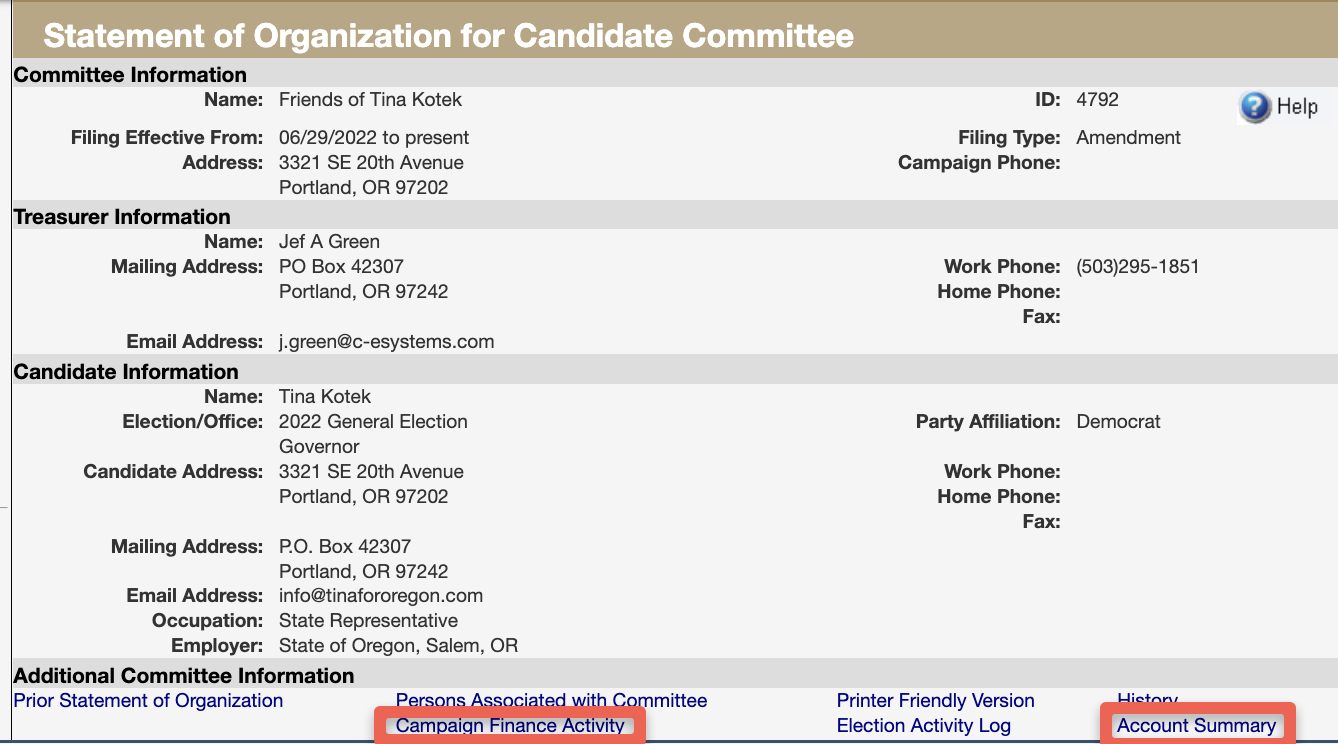
Example of an OreStar Statement of Organization for Candidate Committee.
Potential donor information
You can use OreStar to gather information on people who have donated to races similar to yours, such as people who ran for the same seat, people who live in a certain city or zip code, or people who donated to ballot measures that might be related to your candidacy. You can filter on the Campaign Finance Transactions tab to find these donors and export the data to an Excel file for analysis.
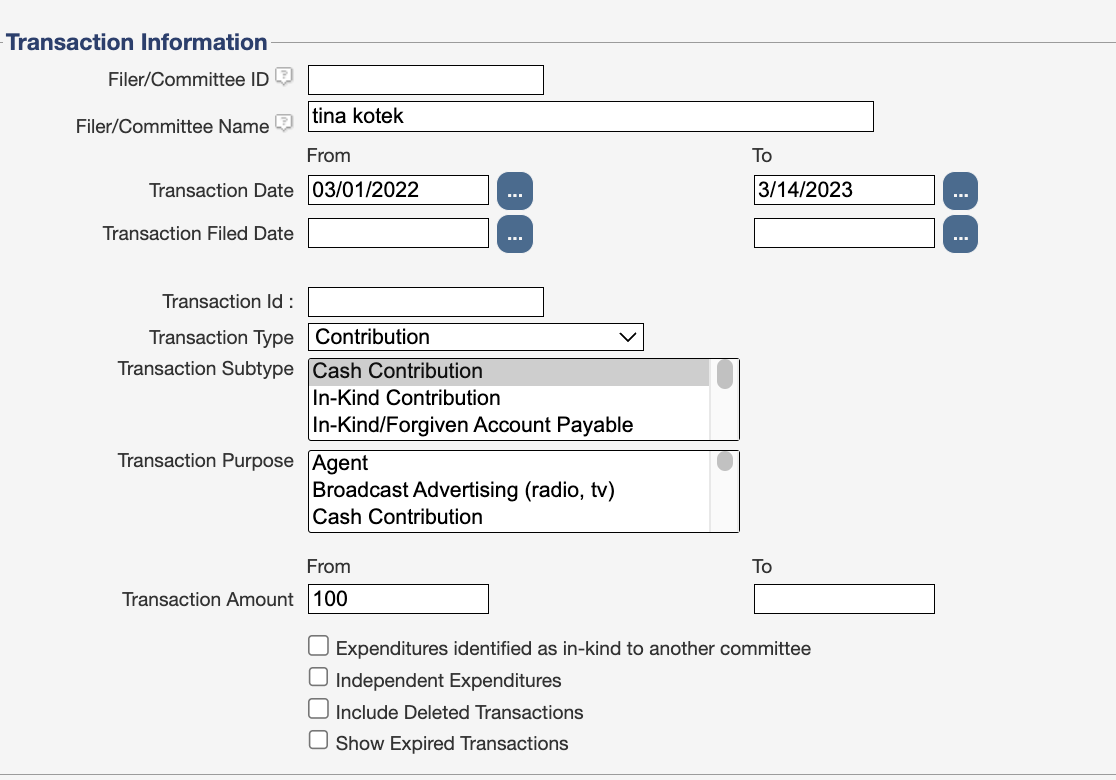
Example of an OreStar search for donors living in zip code 97267 who donated at least $100 to Tina Kotek over one year.
Public speaking basics
by Hester Schell, MFA
Welcome. This tutorial is about the delivery of your speeches to enrich your campaign handshake-by-handshake, doorbell-by-doorbell, speech-by-speech at rally-by-rally. Words matter. Take Roosevelt for example: “We have nothing to fear but fear itself.” FDR lifted an entire nation out of the Great Depression. The next bit of advice is to invest in really comfy shoes. Think like a soldier: take care of your feet.
You have all our support and gratitude. Thank you for running for office. Reach out with questions. Let us begin. You are a candidate. Be Fearless! You can do this.
Ingredients of a Great Speech:
Great Writing: Get Help
Connect with the Audience: Eye Contact
Enough Preparation and Practice: Research and Rehearsal
Know Your Audience: Customize
Clear Messaging: Authenticity
Good Body Awareness: Replace fear with relaxed confidence
Know your material: Bring notes, avoid using devices
The audience is on your side.
Use humor.
Have courage to grow from mistakes: Let it go, don’t worry.
Purpose
Winning elections is in the math: Great Campaigning + Public Speaking + Larger # of VOTES = Successful Campaign.
We make speeches to communicate a message, inspire and motivate action through chosen words. Your physicality also makes an impression on your audience. Composing and delivering an effective and memorable speech is a top priority for a successful campaign. A great speech can do more than motivate votes for you. It can bring essential volunteers to help your campaign.
Alert: There’s homework. If you really want to win, there is no “calling it in,” or last minute prep. Set a schedule. Keep it.
Step One: Research.
What kind of speech(es) do I need? Several platform speeches of varying lengths. A super short highlight introduction.
Who is your audience? Customize: Age, geography, rural, urban?
Length? Your allotted time will vary from campaign stop to stop, event to event. -- Structure is required:
INTRO: Introduce yourself. Tell us why you are here.
BUILD: Back story, personal history. Set up the problem.
MESSAGE: How are You going to fix this problem?
RE-CAP: Who and Why
ACTION ITEM: Register to Vote. Vote for Me. Meet me here. Come volunteer.
THANK YOU: Always thank hosts, sponsors, venue managers.
-- Think like a copywriter. Create a snappy parting quote, something that pops (think song titles) for a sound byte the media could pick up on, such as a repeatable phrase; Biden’s “let’s finish the job,” for example, or “Stop by my office.”
--Learn about set-ups and punchlines, tag lines, alliteration, use of humor. All of that is speech writing.
Homework:
Watch and Learn from the best.
Watch famous speeches: Look for the combination of great delivery and great writing. Find famous speeches on YouTube. Your local library is another great resource.
Make Notes:
Notice where speakers pause, look away and come back, how they pause for a needed sip of water. Listen for a repeated phrase (campaign slogan, opponent dig).
Notice where the speaker waited for the audience to come back to listening, the pause for a laugh, the pause for reflection or dramatic effect. The pausing is important, not only to grab that sip of water, but also because it is one of the tools we use to connect with the audience. It says many things, including “I have your attention, I’m about to proceed.”
Be a better listener. Listening connects the speaker to the audience. While it is usually laughter, sometimes it is heckling. Biden is a master with the hecklers. Learn from his 2023 State of the Union address in February 2023. Sharp wit is part of his armor.
Notice what you like in these great speeches. Why? What can you use?
Three C’s of Public Speaking:
Content: Messaging
Clarity: Diction as well as meaning and intention
Charisma: Holding an audience, keeping the attention
Step Two: Preparation = Armor
What kind of armor works for you? Find out.
What is armor? Protection. Your armor protects you from getting off-track and losing your place in the notes, or flipping your index card too early, stumbling over words. Oops, now you’ve lost it. Bells go off, you start sweating, now you’re losing your breath, you reach for the water, and everyone can see you are shaking. Oh No!!
Worse case scenario: A full on panic attack. Fainting. STOP: It’s only the fear response. It is only ADRENALINE, a naturally occurring hormone. Stop. Fight or Flight. You can learn to work with it.
Best cast scenario: Avoid panic attacks. How? Practice, and by using courage to displace fear. The more you face your fear, face the stage-fright, the more courageous you become. The more courageous you become, the more confident. And you get better and better with your public appearances. Win. Win.
Pausing can be your armor: For a sip of water, a moment to gather thoughts together, get your breathing back under control, listen to the heckler, so you can respond. Not responding, just pausing is also a response.
The right words are armor. Work with a speechwriter to make your speech pop and inspire your voters. There are many tutorials available. You need brilliant, final copy ready to deliver.
Your armor is also your life experience, instinct and intelligence. It’s why you are up there in the first place.
Be Courageous. Be Bold. Be yourself.
Homework:
List your strengths:
Are you good with humor and can deliver a joke? Pause for the laugh?
Have you ever coached kids?
Look to your life experiences. Use these stories. Make them relatable.
Keep this list handy: Why I am running for office. These phrases will save you over and over.
CONGRATULATIONS!
You’ve watched the “Greats.”
Research and writing are done.
Let’s get into DELIVERY.
Four P’s of Public Speaking:
Projection: Volume
Pace: Fast or Slow
Pitch: High or Low
Pauses: Short or Long. For laughs or to make a point?
Step Three: Rehearse
How do you get to Carnegie Hall? Practice.
Public speaking looks easy and spontaneous when speakers appear relaxed, in control and “in the moment.” Experienced politicians get really good at it. Re-elected officials can occasionally get away with little rehearsal. You can’t. Let’s get you ready to get out there with your message.
Homework:
Practice with your family and friends. Choose people you trust. Ask for feedback. It will be valuable. Listen to the feedback.
Re-Write, Rehearse, Repeat. With different people.
You’ve made adjustments to the words, found better words. Or perhaps a trusted friend suggested a better “set-up” or “punch line,” which is NOT offensive, and doesn’t “attack” anyone. Teasing is relatively okay, and we use it a lot. Be careful. Test the waters. Rehearsal and feedback on the writing is a must.
Alert: Understand your racial bias and get help to be sure you understand how your words might be offensive. Never assume you understand what’s offensive.
Alert: Never step up to the microphone unprepared. You get one shot with this crowd.
Alert: Never “test” new material on an audience. There could be opponent supporters waiting for you to trip up, fail, stutter, in any way appear unprepared. For example, notice what has been said to President Biden when he trips up on anything, or the criticism about his age that affects his speech delivery. The world is waiting for you to fail. So is your opponent. The solution? Rehearse.
It’s a good thing the president knows how to handle criticism. You’ll get better at it too.
Step Four: Delivery, The Podium Awaits
You’ve got a date, and there’s the podium. You’ve got a finished written speech, and you’ve rehearsed, polished and timed it. You know which one to use for a five-minute intro of another candidate (you will be asked, so be prepared). You know which one to use when you have ten minutes, and which one to use when you get twenty minutes.
You are ready. You feel good, a bit nervous. You’ve got a date, and there’s the podium. People file in. You’re shaking hands, greeting… and here come the nerves, the excitement… stage fright. …What if I trip on the way up to the podium? What if I….what if I, what if… This is a killer. Don’t let it happen. Focus on success. Focus on winning.
Check your fear reaction. It’s just stage fright. More on adrenaline below.
Trust your preparation.
Trust the words to deliver the message. It’s up to you how to deliver the words.
Good speech needs supported breathing.
Good speech has good articulation, enunciation, emphasis, pitch and volume.
VOICE, BODY AND NERVES
Giving a speech can be terrifying. But you are brave.
You have a message to deliver and people want to hear you. The more you practice, the better it gets. The more you work on your delivery, the better and the more confident you become.
KNOW THE SYMPTOMS: BODY AWARENESS
Listen to your body. Check your symptoms.
The symptoms include increased heart rate, dry mouth, shaking, shortness of breath and shallow breathing, sudden sweating, thirst, and with severe stage fright,
Oxygen is key to getting your breath and heartbeat back under control.
We naturally put up defenses. It is only your body chemistry. Adrenaline is a naturally occurring hormone, triggered anytime you feel the unknown about to thrust you forward.
Your thoughts can turn it around. Find your happy place.
Step aside, go into a closet or the restroom and release the tension in your arms, torso, and shake the entire body, gently, with some deep breathing. Stand still. Check your symptoms. Then, balance on one leg at a time. Balancing changes what you have your mind focused on. Also tapping around the eyes and sternum can be helpful.
Add humming. This helps get the breath under control. Hum while tapping and shaking.
WARM UP: PHYSICAL
About fifteen minutes before “Go Time,” step away. Think about your body: fluids in or out. Yes, too much adrenaline makes you want to go - yet again - to the restroom. Good. Flush out that hormone. Breathe. Drink more water. Blow air through your lips and do your tongue twisters. Good speech is about being understood. Stretch out your face, stretch your tongue and do a few more tongue twisters.
WARM UP: VOCAL
Articulation:
We do those tongue twisters to practice getting away from the popping and hissing which is exaggerated on a microphone. You’ve heard it: hissing and popping. This is all about consonants. C, F, S, V, Z. Say them aloud. These consonants push air while making the sound. Compare to B, D,T, P. These consonants pop in the microphone. The solution is to ease off on the poppers and hissers. Find tongue twisters that work these consonants. Practice with a microphone and learn how you can back off and eliminate hissing ssss and popping ppppp.
TECHNOLOGY
Just because there is a microphone on a stand, at a podium, don’t assume it is functioning properly or if anyone has turned up the volume. You’ve seen it… the tap tap tap. Yes, it’s on.
Find your light. Avoid the shadows.
MICROPHONE BASICS
Leave it alone. It will pick up everything.
Alert: Watch yourself around live microphones.
Microphone placement: Practice!
Do an open mic at a club. You must get comfortable using the microphone.
Even with a microphone, you need to understand how far away it is from your mouth. There is always an element of projecting your voice, speaking up. Avoid speaking softly or being timid. Even eight inches away from a directional mic will impact what does and does not amplify to the speaker system.
Keep the microphone one to two inches away. Don’t eat the microphone: you’ve seen singers right on it.
Leave the microphone on the mic-stand. Anytime you touch it, bump it, adjust the height, it will sound. Staying put eliminates wandering, which can be seen as nervousness. It also keeps both hands free. Gain confidence with using microphones before taking it off the mic-stand and walking through the crowd. When you do walk with a mic, keep it steady in front of you, close to your mouth. Avoid changing hands too often.
Place your cup of water on a stool or something nearby. Keep your hands free.
Keep your hands off the sound cables and the mic-stand. Your body electricity can distort the signals.
TAKE IT WITH YOU TO THE PODIUM: In Your Head
Sure, your speech is on your tablet, or bulleted index cards to help you stay on track. You know the material so well and you are so prepared that you don’t really need to watch the screen. You can get your face up to look at people. Move from face-to-face. Use the pauses to look down and get your bearings, or a sip of water.
Alert: Using your phone gets tricky. Inevitably you will need to scroll. Speakers frequently find themselves lost in their document. It can ruin the moment, disconnect you from the audience, disrupt the flow. Avoid electronic devices. Use index cards.
Helpful Public Speaking Links
Muse Advice- 17 Public Speaking Tips
TopTen Harvard- 10 Tips for Improving Your Public Speaking Skills
Event planning
By Hester Schell, MFA
As a candidate, take the time to review and understand all aspects of your responsibilities surrounding all things events and campaign funding and donations. Understand what is allowed and what is not, along with what is reported on your campaign statements. These pages are not a complete guide, but rather are simply the basics.
Welcome to Event Producing: Pre-Production, Production, Post Production
Pre-Production
Pre-Event: Dates and Space
Press Kit to All Media Outlets: send six weeks to a month in advance
Advertising budget
Word-of-Mouth
Neighborhood online and offline bulletin boards: Post one month to two weeks in advance
Postcard mailers: Deliver one week prior.
Production
Event: Load In
Silent Auction? Live auction? Fashion show? Music stage? Food area? Beer?
Parking. Restrooms. Security.
Post Production
Post Event: Load Out
Thank you cards to all donors and support teams.
Financial breakdown on money raised against expenses.
Final report.
Failure to Plan is a Plan to Fail
Communications, assignment of duties, responsibilities and your leadership will determine whether your event is a successful event. Murphy’s Law is real. In today’s world of mass communication and automation, errors and omissions occur with more frequency. Therefore, consistent follow-up is essential.
Never hesitate to call a venue manager with an urgent question. When phone messaging fails, nothing remedies faster than a quick in-person drop-in. Always have your team visit the venue and take photos. If you have a security detail assigned to the location, have them do a tour for risk assessment, especially exits.
Due diligence means you try to anticipate anywhere Uncle Murphy is hiding. Everyone’s safety, security and liability is up to the person who signs the rental agreement. Take precautions.
Get it in writing: Review the fine print of all contracts, especially when it comes to liability and permitting. Understand what you are signing, especially the “add-ons.”
The Basics- Who What When Where Why
Why: A mission statement will contain the parts of a marketing plan. Why would anyone want to come? Be specific.
Who:
The Candidate(s) and staff
The Audience: seating totals
The Event Manager(s)
Catering and Staff
Musicians, Artists?
Child Care Provided?
What TYPE of EVENT
Full assessment of particular needs: food prep, electrical, capacity, head count.
How large a space is determined by your sales, sign-ups and crowd expectations.
Whichever event profile applies will determine what is required from the type of contract you must sign, how much liability insurance, deposits against damages, type of event insurance to how much backup generator power to run, how many refrigeration units for how many campers at the music festival.
Private property
Private property, open to the public
Private property, private guest list.
Private property FOR HIRE, open to the public.
Private property FOR HIRE, private guest list.
Public Property
Public Property, open to the public.
Public Property, City, County, State Owned Facilities and Parks
By the hour, week. Some on site staff provided, some required.
Permitted and insured, scheduled. Indoor and Outdoor.
Alcohol permits, restrictions and/or limitations. Insurance requirements.
Public property, private guest list. Free. FCFS (first-come, first-served)
Public property FOR HIRE, open to the public. (reserved: a ballroom at a national park to the basketball court in your city-run parks department.)
Public property FOR HIRE, private guest list. (reserved: wedding in a national park, lodge or the softball field every Thursday from May to end of June in your neighborhood.)
Staffing Events
Resources: Volunteer sign-ups with specific tasks.
Do a “basic skills assessment” during volunteer intake.
Research: caterers and event producers.
Co-Sponsor: Partner with a non-profit for a percentage of any proceeds.
The places to find experienced professionals who know how to do this - how to produce an event - are theater workers, film and touring road crews. In the film industry, they are called “location managers” and “unit production managers.” Theatrical producers and stage managers know just about everything about logistics for live events. Anyone with experience booking bands in a bar would easily pick up the necessary skills to help you plan events. Be sure to check references and look for verification of prior contracts. Ask Uncle Murphy if you’ve missed anything. He’ll find it for you.
When Seasonal. Work with the established holidays. (Halloween Fundraiser, May Day Rally for Workers, International Poets Day.) Build a theme around historical figures relative to your campaign platform. Wet or Dry Season? Book parks with sheltered picnic areas.
Morning, Noon or Night - Breakfast Stumping with the Rotary? Lions Club? Knights of Columbus? Elks? Brown Bag Lunch with the Candidate, local park. Sit-down, 10K per table black-tie in a ballroom with Pink Martini.
Book In Advance: All venues have managers. Some calendars are online. Plan months ahead.
Public Parks are reserved through a community’s parks and recreation departments.
Where
Event Space: Indoors or Outdoors. Day or Night?
Outdoors: All you need is hay bales and a field or a step stool in a park. And another field for parking.
Indoors: The bigger the ballroom, the higher the price tag. Hotel packages include assorted levels of staffing.
Whatever the space, distinguish its functions:
Seating, Staging.
Backstage, Onstage.
Equipment/audio gear set-up.
Press/Media table: clipboards for volunteer sign-ups, printed campaign materials, buttons, printed platform bullets
Stumping outdoors? Get a decent portable microphone amplifier. Compare model specifics for reach distance.
Bars and Taverns frequently have a party space by reservation for free and rental.
You cover the wages of the bartenders. Sometimes there is a set-up fee.
Free comes when you can guarantee a level of alcohol sales. There can be a minimum spent before any benefits kick in
Must haves:
Access to electricity or a generator.
Access to restrooms.
Access to drinking water.
Clear entry and exits. Parking.
Nice to have: Coffee. Snacks. Merchandise. Clipboards for sign-ups.
Leave home: Alcohol. If you are permitting through a city’s parks department, it is likely alcohol will be prohibited.
Don’t forget: Donation bucket or basket, or a hat to pass. Printed materials for distribution.
Keys to Success
Avoiding Traps- Never underestimate how easily lack of planning turns into utter chaos.
SOLUTION: PREPARATION AND PLANNING.
Yes, you most likely need:
An event manager/producer/stage manager
A permit: Start at City Hall
Event insurance: Start with your own auto/home insurance provider. Riders on an existing policy can be quite reasonable when available.
Check with the venue operator whether you are covered via rental agreement.
Venues book many months in advance.
Persistence Matters.
Don’t take it personally. Every event venue is understaffed. Plan accordingly.
Safety and Security are top priorities. For large events, alert the local firehouse and police department. Depending on your head count estimate on any permits issued by a municipality, the police will likely know about it. It’s good to let them know directly.
Follow the rules of whatever event location you find yourself.
Equipment rental generally requires proof of insurance receipt and a policy number.
Figure out the parking and drop off/pick up for full accessibility. Include it in the press release, invitations and all marketing efforts.
Sign language interpreters?
Land acknowledgements are more prevalent. Find yours. Respect. For Clackamas County, check with the Grand-Ronde Tribal Council. There are maps and overlays to see which tribe to name:
VIP section? Increased security? Preferred Seating? Donor/Candidate meet and greet?
Credentialed Press: Alert each editor so there is time to make a reporter assignment to your event.
Have an emergency plan.
Have a system to report suspicious activity. Do not underestimate the ability of one unhappy or angry person in the crowd to make life unpleasant for everyone. Do not underestimate the need for hyper vigilance with checking backpacks before entry, or not allowing glass bottles.
Use Walkie-Talkie and headsets when you have longer distances to get from the holding tank to the stage.
Alert: Insufficient staffing leads to chaos. The event manager is responsible to avoid chaos at all times by keeping things under control by anticipating problems. Anyone on your team who impedes the schedule and tasks assigned will naturally contribute to chaos.
Alert: Have a fast-action exit plan. In the event of compromised security or any need for a quick exit out the back, plan accordingly with where you park VIP vehicles.
Clackamas County Resources
Ideas for Affordable Event Space
Local Schools
Local Churches, Temples
How to use NGP VAN
What is NGP VAN?
VAN (short for Voter Action Network) is a database of voter information. In Oregon, it’s maintained by the Democratic Party of Oregon (DPO.) All voters in the state have a record in VAN. The information in VAN is crucial to campaigns.
How to get access to NGP VAN
To get access to VAN, send an email to the chair@clackamasdems.org and fill out the DPO VAN Agreement. The DPO provides VAN access only to candidates, not for ballot measure campaigns.
What you can do with the information in NGP VAN
VAN has many functions. Using VAN you can:
Generate lists of voters that meet your criteria (such as frequent voters, voters of a certain age, voters in a particular area, etc.) for use in GOTV campaigns
Create walk lists
Track information on voter contacts
Create email and phone bank campaigns
Create and manage events
Record results of canvasses
Record answers to surveys
Learn more about using NGP VAN
The DPO maintains a training site for VAN. (The password is “democrats”.) The Texas Democrats have auseful VAN manual. NGP VAN, the company behind VAN, also offers a training manual.
Candidate Resources
Get candidate resources for running for office including:
Candidate Statements
Campaign Finance Information
Election Resources
Help and Training for First-Time Candidates